Halibut Gravlax with Kaffir Lime, Thai Basil & Red Chili
25 hrs · Advanced · Serves 4
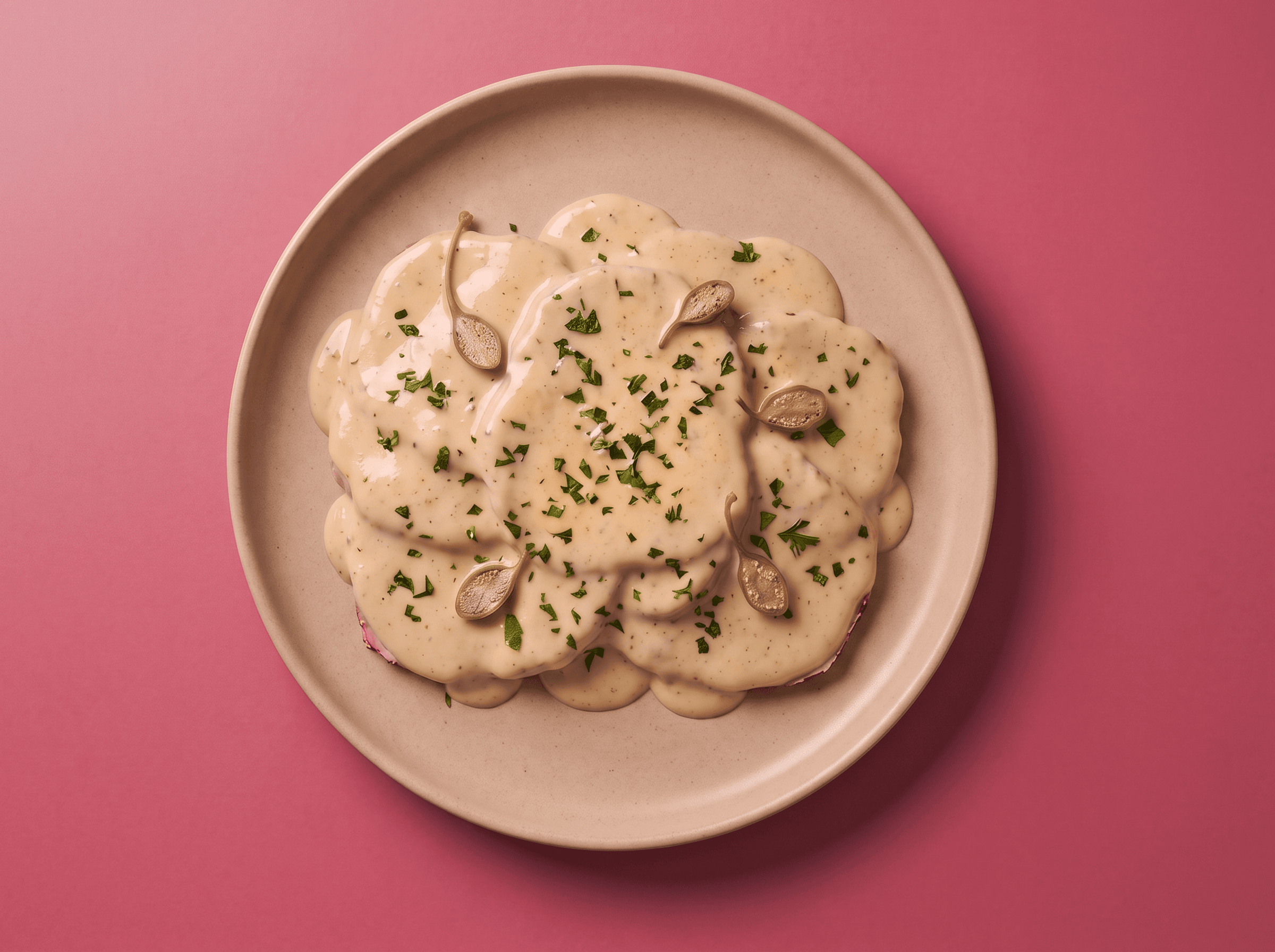 From our menuVitello Tonnato€17.50 · Made by us, delivered chilled.
This is a cold-cured halibut — no heat, no cooking — where salt, sugar, and Thai aromatics slowly transform raw fish into something silky, deeply flavored, and elegant. The secret is 18–24 hours in the fridge under a little weight. It serves 4 as a beautiful starter or aperitif bite.
Recipe by Christophe Rammant
Cordon Bleu Paris alumni - Two star Michelin kitchen experience
How Does Salt Turn Raw Fish Into Something So Silky and Flavorful?
Traditional Nordic gravlax technique uses salt and sugar to pull moisture out of the fish through osmosis — the same way pickling works. As the moisture leaves, the fish firms up gently and the flavors of the cure move in. Food science shows this process creates a texture that is silky and tender, not cooked, not raw — something in between that melts on the tongue.
Professional chefs know that removing the skin before curing is a game-changer. Without the skin acting as a barrier, the cure works on all sides of the fish at once. This means more even seasoning all the way through — no salty outside and bland center. It also means cleaner, prettier slices at the table.
The white miso and fish sauce are the quiet heroes here. Food science shows that both ingredients are packed with umami — that deep, savory, mouth-coating flavor. They don't taste like miso or fish sauce in the finished dish. They just make the kaffir lime, Thai basil, and lemongrass taste richer and more complex, like the volume has been turned up on every other flavor.
Estimated nutrition per serving
Estimated from ingredient weights, not lab-tested.
- Calories
- 450
- Protein
- 41g
- Fat
- 22g
- Carbohydrates
- 22g
The weekly recipe note
Enjoyed this recipe? Get the next one first.
One new recipe each week from Christophe: global flavor, French technique, and practical home-cook timing.
By signing up, you agree to receive emails from Mr. Saucy.
Ingredients
Recipe yields 4 servings
For the Halibut Cure
| Amount | Ingredient | Notes |
|---|---|---|
| 800 g | Halibut fillet, skin removed, pin-boned | One thick center-cut piece — ask your fishmonger to remove the skin and all pin bones. Skinless cures evenly on both sides and slices far cleaner at serving |
| 80 g | Coarse sea salt (fleur de sel or gros sel) | Do not use fine salt — it goes in too fast and can over-salt the fish |
| 40 g | Caster sugar | The classic Nordic 2:1 salt-to-sugar ratio — the sugar balances the salt and helps the cure stick |
| 20 g | White miso paste (shiro miso) | Your invisible flavor booster — mix it in fully so it blends into the cure |
| 10 g | Kaffir lime leaves, fresh or frozen | About 8–10 leaves — remove the central rib and slice into very thin ribbons (chiffonade) |
| 6 g | Kaffir lime zest (or regular lime zest as fallback) | Zest of about 2 kaffir limes — use a microplane and avoid the bitter white pith underneath |
| 20 g | Thai basil leaves, fresh | Roughly torn, not chopped — tearing releases the oils gently without turning the edges bitter |
| 4 g | Red chili flakes (dried) | Mild heat — Thai dried chili flakes work best here; adjust to your taste |
| 10 g | Fish sauce (Tiparos or Megachef) | Adds deep savory flavor without tasting fishy — it blends invisibly into the cure |
| 3 g | White pepper, freshly ground | More fragrant than black pepper in a cold cure — a nod to the Nordic spice tradition |
| 15 g | Lemongrass stalk, inner core only | Use a microplane or mince very finely — coarse pieces won't soften or penetrate the fish |
For the Kaffir Lime Crème Fraîche
| Amount | Ingredient | Notes |
|---|---|---|
| 150 g | Full-fat crème fraîche | Full-fat gives the best texture and richness alongside the delicate fish |
| 4 g | Kaffir lime zest | Microplaned — stir in at least 2 hours before serving so the citrus oils fully bloom into the cream |
| 5 g | Fish sauce | Just a few drops — this replaces salt and adds a quiet savory depth to the cream |
For the Quick-Pickled Zucchini
| Amount | Ingredient | Notes |
|---|---|---|
| 300 g | Zucchini (courgette), trimmed | Use small, firm zucchini — slice into thin ribbons with a mandoline or vegetable peeler, or cut into 3 mm rounds |
| 80 g | Rice wine vinegar | Mild and gentle — won't overpower the delicate fish; white wine vinegar works as a substitute |
| 80 g | Water | Dilutes the vinegar for a softer, more balanced pickle |
| 15 g | Caster sugar | Balances the acidity of the vinegar — adjust to your taste |
| 6 g | Fine sea salt | Seasons the brine and draws a little moisture from the zucchini |
| 3 g | Kaffir lime leaf, whole | 1–2 leaves — bruise them before adding to the brine so they tie the pickle flavors to the cure |
| 10 g | Red chili, deseeded, thinly sliced | Optional — adds a gentle warmth and a pop of color that echoes the cure |
For Garnish and Plating
| Amount | Ingredient | Notes |
|---|---|---|
| 8 g | Micro Thai basil or shiso | Micro herbs only — full-size leaves are too strong at this scale |
| 6 g | Fresh red chili, deseeded, cut into tiny cubes (brunoise) | A visual signal of heat — use sparingly |
| 20 g | Wild garlic oil | Drizzle sparingly at the very last moment before serving — it should accent the dish, not take over |
Instructions
The Night Before — Cure the Fish
- 1
Check the Fish (The Quality Step You Cannot Skip)
Pat the halibut completely dry with paper towel. Run your fingertip slowly along the flesh to feel for any remaining pin bones — press gently and you will feel a tiny hard bump if one is hiding. Pull out any you find with tweezers or needle-nose pliers. A single missed bone in a cured dish is a serious problem, so take your time here. If any patches of skin remain, use a thin flexible knife to trim them away cleanly.
- 2
Mix the Cure (Where the Flavor Happens)
In a bowl, combine the coarse salt, caster sugar, white miso, fish sauce, white pepper, chili flakes, finely minced lemongrass, kaffir lime zest, and the thinly sliced kaffir lime leaves. Mix everything together thoroughly until the miso is fully blended in — you should not see any separate lumps of miso. The miso acts like a glue that helps all the aromatics stick to the fish surface.
- 3
Wrap and Coat the Fish (Even Coverage Is Everything)
Lay a double layer of cling film on your work surface — make it large enough to wrap the whole fillet with room to spare. Spread one-third of the cure mixture in a thin, even layer on the film. Lay the halibut on top, then pack the remaining cure evenly over the top and all sides of the fillet. Because there is no skin, the cure will work on every surface at once — this is what gives you even seasoning all the way through. Now scatter the torn Thai basil leaves over the cure-coated fish. The salt will gently draw the basil oils into the flesh over the curing time.
- 4
Wrap Tight and Add Weight (The Press That Shapes the Fish)
Wrap the fillet tightly in the cling film — no air pockets. Wrap it again in a second layer for extra security. Place it in a deep tray or baking dish, set a second tray on top, and weigh it down with 1–2 kg of something heavy (canned goods from your pantry work perfectly). The weight presses the cure into the flesh evenly and firms up the fish so it slices cleanly later. Refrigerate at 36–39°F / 2–4°C.
- 5
Cure for 18–24 Hours (Set a Timer — This Is Non-Negotiable)
Leave the fish in the fridge for 18 hours for a lighter, more delicate result, or 24 hours for a firmer, more pronounced cure. Do not go beyond 24 hours — halibut is thinner and denser than salmon and will turn chalky and over-salty with no way to fix it. Because the skin is removed and the cure works from both sides, check the fillet at 16 hours by slicing a thin piece from the edge and tasting it. It may be ready earlier than you expect. Turn the wrapped parcel once at the halfway point so the cure distributes evenly.
Day Of — Rinse, Rest, and Make the Accompaniments
- 6
Rinse and Dry the Fish (Remove the Surface Cure)
Unwrap the cured fillet and rinse it briefly under cold running water to wash away the surface cure — do not soak it or leave it sitting in water. Pat it completely dry with paper towel. The flesh should feel firm but still a little yielding when you press it gently, with a slight translucency at the edges. That is exactly what you want.
- 7
Rest the Fish (Let the Seasoning Even Out)
Wrap the clean fillet in fresh cling film and return it to the fridge for at least 2 hours before slicing. Food science shows that this resting time allows the salt to spread evenly from the outside to the center of the fish — without it, the edges taste saltier than the middle. This step is what gives you consistent, balanced seasoning in every slice.
- 8
Make the Kaffir Lime Crème Fraîche (Give It Time to Bloom)
Combine the crème fraîche, kaffir lime zest, and fish sauce in a small bowl. Whisk briefly until everything is incorporated. Cover and refrigerate for at least 2 hours. The waiting time is important — the citrus oils from the zest need time to fully infuse into the cream. If you taste it right away it will seem sharp; after 2 hours it will be smooth, fragrant, and rounded.
- 9
Make the Quick-Pickled Zucchini (Fresh Acidity for the Plate)
Combine the rice wine vinegar, water, caster sugar, and fine salt in a small saucepan. Bring to a gentle simmer over medium heat, stirring until the sugar and salt dissolve completely — do not let it boil hard. Add the bruised kaffir lime leaf and sliced chili, then remove from the heat and let it cool for 5 minutes. Pour the warm brine over the sliced zucchini in a heatproof bowl. Press a piece of cling film directly onto the surface of the zucchini so everything stays submerged. Leave at room temperature for 30–45 minutes, then transfer to the fridge until you are ready to plate. The zucchini should be tender but still have a little bite, with a bright, fresh acidity.
Serving — Slice and Plate
- 10
Slice the Gravlax (The Technique That Makes It Beautiful)
Take the fillet straight from the fridge — cold fish holds its shape much better under the knife. Use a long, thin slicing knife and cut at a 30–45 degree angle against the grain in long, smooth strokes. Do not saw back and forth. Aim for slices about 3–4 mm thick. Wipe the blade clean between each cut to prevent tearing. Without skin, the fillet is more yielding and easier to slice cleanly than a traditional skin-on gravlax.
- 11
Plate and Finish (The Last-Minute Details That Make It Special)
Place 3–4 slices of gravlax on each chilled plate. Add a small spoonful or quenelle of kaffir lime crème fraîche alongside. Arrange a small bundle of pickled zucchini ribbons next to the fish. Now drizzle the wild garlic oil very sparingly across the plate — 3 to 4 drops is enough; more will overpower the delicate fish. Scatter a few micro Thai basil leaves and a pinch of brunoise red chili over the top. Finish with a tiny pinch of fleur de sel directly on the fish slices and serve immediately.
The weekly recipe note
Enjoyed this recipe? Get the next one first.
One new recipe each week from Christophe: global flavor, French technique, and practical home-cook timing.
By signing up, you agree to receive emails from Mr. Saucy.
Tips & Tricks
You are not sure if the fish is ready at the 16-hour mark:
Slice a thin piece from the very edge of the fillet and taste it. It should taste seasoned and silky — not raw, not chalky. If it still tastes like raw fish, give it 2 more hours. If it already tastes a little salty, pull it now and rinse immediately. Halibut cures faster than salmon, so checking early is always the right move.
The gravlax tastes too salty after curing:
You cannot remove salt once it is in, but you can balance it at the table. Serve a more generous spoonful of crème fraîche alongside each portion and add a few drops of fresh lime juice directly on the sliced fish. The acidity cuts through the saltiness on the palate. For your next batch, reduce the cure time by 2–3 hours or drop the salt to 70 g per 800 g of fish.
Your kaffir lime leaves are frozen, not fresh:
Frozen leaves are often more intense than fresh ones because the freezing process breaks down the cell walls and releases more of the aromatic oils. Reduce the quantity by about 20% — so use around 8 g instead of 10 g — and taste the cure mixture before applying it to the fish.
The pickled zucchini has gone soft and lost its bright green color:
This happens when the zucchini sits in the brine too long. The pickle is best made the day of serving — no more than a few hours ahead. If you need to prep ahead, slice the zucchini and store it dry in the fridge, then make the brine in advance and combine them just 30–45 minutes before you plate.
You are worried about using too much wild garlic oil:
Pour the oil into a small squeeze bottle for control. Three to four drops per plate is the right amount — it should leave a faint grassy, garlicky warmth in the background, not a puddle on the plate. If you do not have a squeeze bottle, dip a teaspoon in and let it drip from the tip.
You cannot find kaffir lime leaves or kaffir lime zest:
Use regular lime zest as your fallback for the zest. For the leaves, a combination of regular lime zest and a tiny drop of lemongrass oil gets you closer to the floral, perfumed character of kaffir lime. Bergamot zest is another good substitute with a similar fragrant quality.
You are not sure if the fish is ready at the 16-hour mark:
Slice a thin piece from the very edge of the fillet and taste it. It should taste seasoned and silky — not raw, not chalky. If it still tastes like raw fish, give it 2 more hours. If it already tastes a little salty, pull it now and rinse immediately. Halibut cures faster than salmon, so checking early is always the right move.
The gravlax tastes too salty after curing:
You cannot remove salt once it is in, but you can balance it at the table. Serve a more generous spoonful of crème fraîche alongside each portion and add a few drops of fresh lime juice directly on the sliced fish. The acidity cuts through the saltiness on the palate. For your next batch, reduce the cure time by 2–3 hours or drop the salt to 70 g per 800 g of fish.
Your kaffir lime leaves are frozen, not fresh:
Frozen leaves are often more intense than fresh ones because the freezing process breaks down the cell walls and releases more of the aromatic oils. Reduce the quantity by about 20% — so use around 8 g instead of 10 g — and taste the cure mixture before applying it to the fish.
The pickled zucchini has gone soft and lost its bright green color:
This happens when the zucchini sits in the brine too long. The pickle is best made the day of serving — no more than a few hours ahead. If you need to prep ahead, slice the zucchini and store it dry in the fridge, then make the brine in advance and combine them just 30–45 minutes before you plate.
You are worried about using too much wild garlic oil:
Pour the oil into a small squeeze bottle for control. Three to four drops per plate is the right amount — it should leave a faint grassy, garlicky warmth in the background, not a puddle on the plate. If you do not have a squeeze bottle, dip a teaspoon in and let it drip from the tip.
You cannot find kaffir lime leaves or kaffir lime zest:
Use regular lime zest as your fallback for the zest. For the leaves, a combination of regular lime zest and a tiny drop of lemongrass oil gets you closer to the floral, perfumed character of kaffir lime. Bergamot zest is another good substitute with a similar fragrant quality.
Frequently Asked Questions
Can I use regular lime instead of kaffir lime?
Yes, but the flavor will be different. Kaffir lime has a floral, almost perfumed citrus character that regular lime cannot fully replicate. If kaffir lime is unavailable, combine regular lime zest with a tiny drop of lemongrass oil to get closer. Bergamot zest is another good substitute with a similar fragrant, floral quality.
Why remove the skin before curing rather than after?
Removing the skin first lets the cure work on all sides of the fish at once, giving you even seasoning from edge to center. It also makes slicing much cleaner at serving — no rubbery skin edge to cut through. The trade-off is that the cure works a little faster, so check the fillet at 16 hours rather than waiting the full 24.
How far ahead can I cure the halibut for a dinner party or event?
Cure the fish up to 24 hours before your event, then hold the cleaned, unsliced fillet wrapped tightly in cling film for up to 48 hours after curing at 36–39°F / 2–4°C. Slice only at the moment of serving. Pre-sliced gravlax oxidizes at the cut edges within a few hours and loses its beautiful appearance and texture.
How far ahead can I make the pickled zucchini?
Make it the day of serving — it loses its bright green color and pleasant crunch if it sits in the brine overnight. If you need to get ahead, slice the zucchini and store it dry in the fridge, then make the brine in advance and combine them 30–45 minutes before you are ready to plate.
Can I scale this up for a larger group?
Yes — the cure ratio scales in a straight line. Keep the 2:1 salt-to-sugar ratio and keep all the aromatics proportional to the fish weight. For fillets over 1.5 kg, add 4–6 hours to the cure time and make sure the weight pressing down on the fish is heavier and covers the whole surface evenly.
Does the wild garlic oil clash with the Thai aromatics?
No — it actually brings them together. Wild garlic has a soft, grassy, herbal quality that sits comfortably alongside kaffir lime and Thai basil without competing. It echoes the green-herb tradition of classic Nordic gravlax while bridging the Thai flavors. The key is restraint — 3 to 4 drops per plate, not a generous drizzle.
What if I cannot taste the miso or fish sauce — did I add enough?
That is exactly the goal. Neither ingredient should be detectable on its own in the finished dish. Their job is to add umami depth that makes all the other flavors taste richer and more complex. If you can clearly taste miso or fish sauce in the cured fish, you have used too much. Invisible is the right result.
What if I do not have a long slicing knife?
Use the longest, thinnest knife you have — a carving knife works well. The most important things are that the blade is very sharp and that you use long, smooth strokes without sawing. A cold fillet straight from the fridge will hold its shape much better under the knife, so do not let it warm up before slicing.
Can I use regular lime instead of kaffir lime?
Yes, but the flavor will be different. Kaffir lime has a floral, almost perfumed citrus character that regular lime cannot fully replicate. If kaffir lime is unavailable, combine regular lime zest with a tiny drop of lemongrass oil to get closer. Bergamot zest is another good substitute with a similar fragrant, floral quality.
Why remove the skin before curing rather than after?
Removing the skin first lets the cure work on all sides of the fish at once, giving you even seasoning from edge to center. It also makes slicing much cleaner at serving — no rubbery skin edge to cut through. The trade-off is that the cure works a little faster, so check the fillet at 16 hours rather than waiting the full 24.
How far ahead can I cure the halibut for a dinner party or event?
Cure the fish up to 24 hours before your event, then hold the cleaned, unsliced fillet wrapped tightly in cling film for up to 48 hours after curing at 36–39°F / 2–4°C. Slice only at the moment of serving. Pre-sliced gravlax oxidizes at the cut edges within a few hours and loses its beautiful appearance and texture.
How far ahead can I make the pickled zucchini?
Make it the day of serving — it loses its bright green color and pleasant crunch if it sits in the brine overnight. If you need to get ahead, slice the zucchini and store it dry in the fridge, then make the brine in advance and combine them 30–45 minutes before you are ready to plate.
Can I scale this up for a larger group?
Yes — the cure ratio scales in a straight line. Keep the 2:1 salt-to-sugar ratio and keep all the aromatics proportional to the fish weight. For fillets over 1.5 kg, add 4–6 hours to the cure time and make sure the weight pressing down on the fish is heavier and covers the whole surface evenly.
Does the wild garlic oil clash with the Thai aromatics?
No — it actually brings them together. Wild garlic has a soft, grassy, herbal quality that sits comfortably alongside kaffir lime and Thai basil without competing. It echoes the green-herb tradition of classic Nordic gravlax while bridging the Thai flavors. The key is restraint — 3 to 4 drops per plate, not a generous drizzle.
What if I cannot taste the miso or fish sauce — did I add enough?
That is exactly the goal. Neither ingredient should be detectable on its own in the finished dish. Their job is to add umami depth that makes all the other flavors taste richer and more complex. If you can clearly taste miso or fish sauce in the cured fish, you have used too much. Invisible is the right result.
What if I do not have a long slicing knife?
Use the longest, thinnest knife you have — a carving knife works well. The most important things are that the blade is very sharp and that you use long, smooth strokes without sawing. A cold fillet straight from the fridge will hold its shape much better under the knife, so do not let it warm up before slicing.
Recipe Reviews
No reviews yet — Be the first to review this recipe!
The collection
All recipesOlive Oil Chocolate Mousse Recipe with Candied Orange
This olive oil chocolate mousse recipe makes a rich but airy dessert with dark chocolate, fruity olive oil, bright candied orange, and crisp almond tuiles. A warm sugar syrup gives the yolks body, while softly whipped cream keeps the mousse light. Plan about 5 hours, including chilling, for 4 generous servings.
300 min · Intermediate · Fusion
Celeriac Ravioli with Brown Butter and Pear
This celeriac ravioli recipe makes 24 delicate pasta pillows filled with roasted celeriac, aged Comté, mascarpone and truffle. Roast the celeriac for deep flavor, then finish the ravioli in a glossy brown-butter sauce with pear, hazelnuts and sage. Plan on 145 minutes for 4 servings, including resting and chilling.
145 min · Intermediate · Fusion
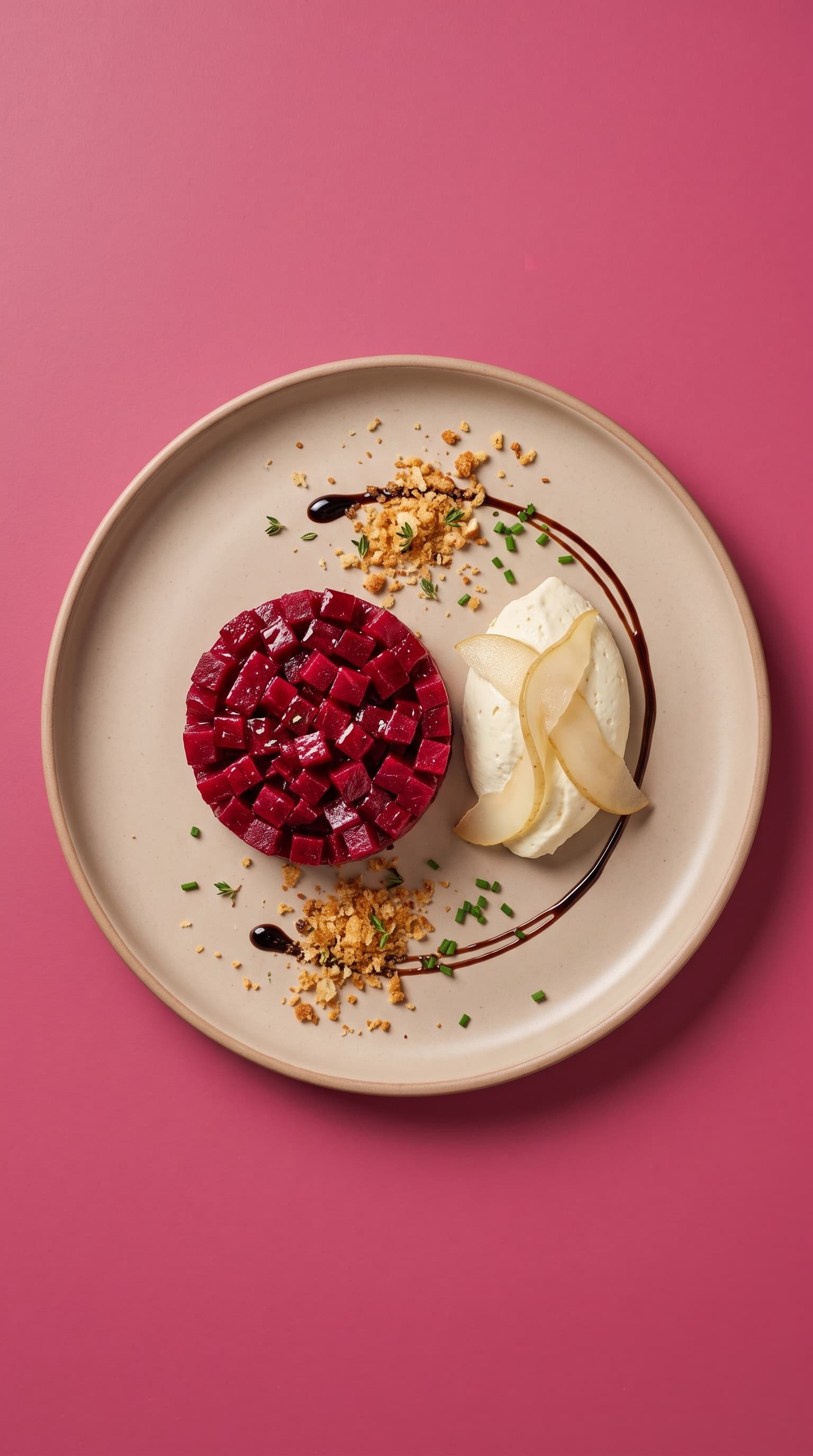
Beetroot Tartare Recipe with Whipped Goat Cheese
This beetroot tartare recipe turns sweet roasted beetroot into a bright, elegant appetizer for four. Cut the chilled beetroot into tiny cubes, dress it just before serving, and pair it with whipped goat cheese, pickled pear, and a buttery hazelnut crumb. Allow about 2 hours from roasting to plating.
120 min · Intermediate · Fusion