

Red Wine-Infused Chicken Adobo Grand Veneur
Prefer not to cook?
Order Red Wine-Infused Chicken Adobo Grand Veneur as a ready-made meal and get it delivered to your door.
Order this meal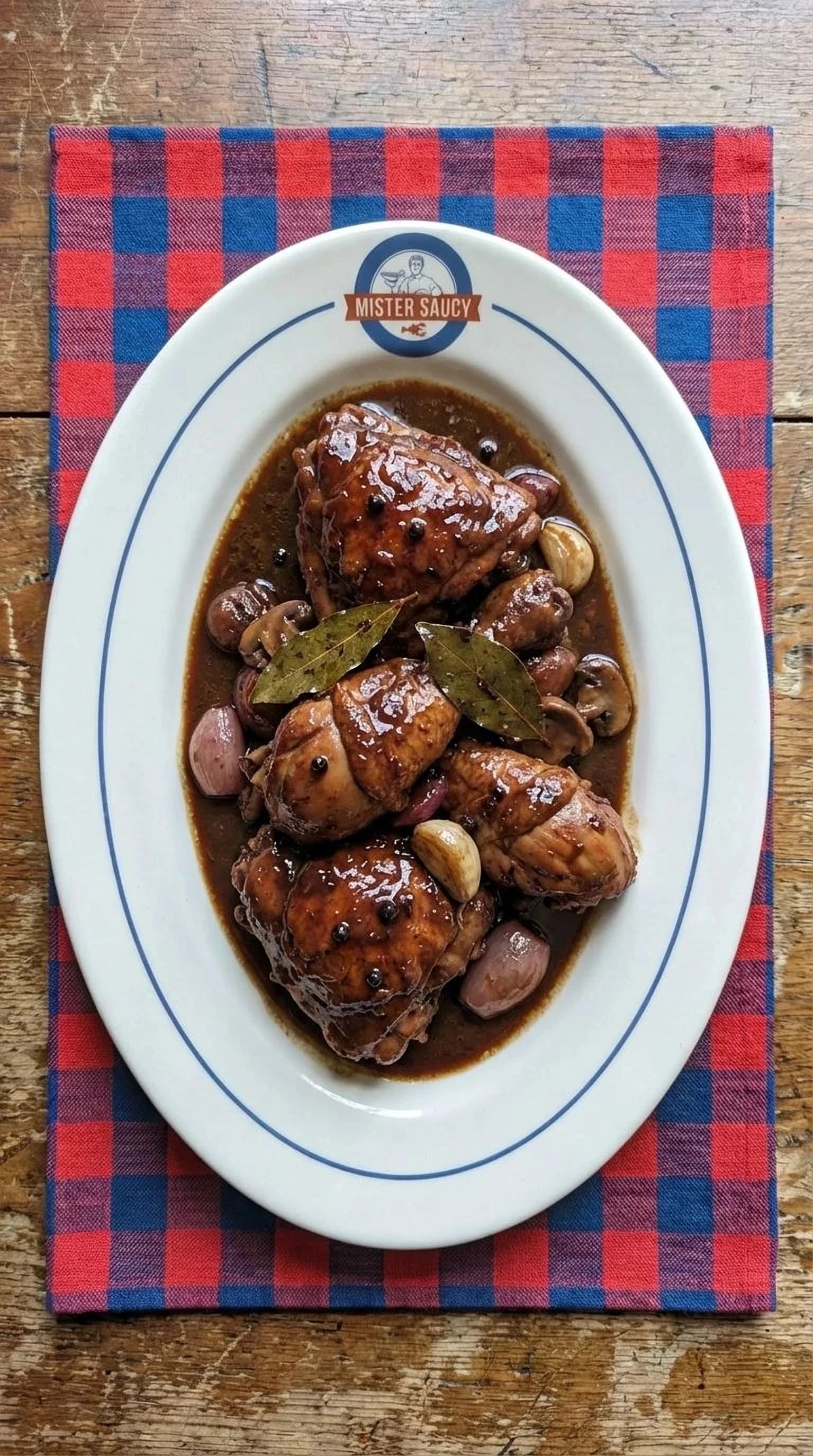
This dish combines Filipino adobo with French cooking techniques to create a restaurant-quality meal. You'll sear chicken pieces, build a rich sauce with red wine and demi-glace, then braise everything in the oven for 95 minutes total. The result feeds 4 people with a silky, deeply flavored sauce that balances tangy vinegar with aromatic ginger.

Recipe by Mr Saucy aka Christophe
Christophe is a culinary professional with expertise in French and global cuisine. He has developed recipes and cooking techniques that bridge traditional methods with modern home cooking approaches. Christophe focuses on making classic culinary techniques accessible to home cooks through clear instruction and practical applications. He studied at Le Cordon Bleu Paris and has work experience at a two star Michelin restaurant.
Homecook turned pro with a Cordon Bleu Paris graduate
Quick Info
How Does This Transform Simple Adobo into Restaurant-Quality Cuisine?
Traditional French technique uses the 'singer' method—dusting aromatics with flour before adding liquid. This creates a smooth, naturally thickened sauce without lumps, giving you that velvety texture you find in fine dining.
Professional chefs know that reducing wine 'au sec' (until almost dry) concentrates the sugars and tannins into a syrupy base. This builds layers of flavor that regular simmering can't achieve, turning ordinary wine into liquid gold.
Food science shows that demi-glace contains gelatin from bones that coats your tongue and creates that lip-smacking richness. When you finish with cold butter (monter au beurre), the fat emulsifies into the sauce and adds a glossy shine that makes the dish look as good as it tastes.
Ingredients
Recipe yields 4 servings
For the Chicken
| Amount | Ingredient | Notes |
|---|---|---|
| 1.6 kg (3.5 lbs), broken into 8 pieces | whole organic chicken | keep the backbone and wing tips for the sauce base |
| 30 g (2 tablespoons) | neutral oil or lard | for searing |
For the Aromatics
| Amount | Ingredient | Notes |
|---|---|---|
| 250 g (2 medium), thinly sliced | yellow onions | provides sweetness and body to the sauce |
| 80 g (1/3 cup), julienned or minced | fresh ginger | heavily loaded for a sharp, aromatic punch |
| 60 g (12-15 cloves), smashed | garlic cloves | — |
| 80 g (2 large), finely minced | shallots | the French aromatic base |
| 5 g (1 tablespoon) | whole black peppercorns | to be toasted with the aromatics |
| 2 g (3-4 large leaves) | dried bay leaves | — |
For the Sauce
| Amount | Ingredient | Notes |
|---|---|---|
| 20 g (2 tablespoons) | all-purpose flour | for the 'singer' technique to provide body |
| 500 ml (2 cups), Cabernet Sauvignon or Syrah | full-bodied red wine | high tannin wines provide better structure for the reduction |
| 120 ml (1/2 cup) | cane vinegar | traditional Filipino acidity |
| 100 ml (1/3 cup + 1 tablespoon), Silver Swan or similar Filipino brand | soy sauce | provides the essential salt and umami profile |
| 300 ml (1 1/4 cups) | beef or veal demi-glace | replaces stock for a heavy, rich, professional sauce consistency |
| 50 g (3 1/2 tablespoons), cold and cubed | unsalted butter | for 'monter au beurre' to finish the sauce |
Instructions
Sear the Chicken
- 1
Dry and Season the Chicken
Pat the chicken pieces completely dry with paper towels and season lightly with salt. Moisture prevents browning, and we need a deep golden crust to build the foundation of flavor for the sauce.
- 2
Sear Until Golden Brown
Heat the oil or lard in a heavy Dutch oven over medium-high heat (around 375°F / 190°C). Sear the chicken pieces skin-side down first until deeply browned and the fat has rendered, about 5-6 minutes per side. Remove the chicken and set aside on a plate.
Build the Sauce Base
- 3
Caramelize the Aromatics
In the same pot with the chicken fat, sauté the sliced onions, minced shallots, and ginger over medium heat until the onions turn golden brown and the ginger smells sharp and fragrant, about 8-10 minutes. This caramelization adds sweetness that balances the vinegar later.
- 4
Toast the Garlic and Peppercorns
Add the smashed garlic and peppercorns, cooking for another minute while stirring constantly. You want to release their oils without burning the garlic—when you smell the garlic strongly, it's ready.
- 5
Apply the Singer Technique
Dust the aromatics with the flour and cook for 2 minutes while stirring continuously. This French technique toasts the flour and coats the vegetables, which ensures the final sauce has a smooth, thickened body without any raw flour taste.
- 6
Reduce the Wine Au Sec
Pour in the red wine and scrape up all the browned bits from the bottom of the pot with a wooden spoon. Increase heat to medium-high and reduce the liquid by two-thirds until it becomes thick and syrupy (au sec), about 12-15 minutes. This concentrates the wine's sugars and tannins into a powerful flavor base.
Braise the Chicken
- 7
Combine and Braise
Add the soy sauce, cane vinegar, bay leaves, and demi-glace to the pot, stirring to combine. Return the chicken pieces skin-side up so they stay crispy. Cover the Dutch oven with a tight-fitting lid and place in a preheated 160°C / 325°F oven for 35-40 minutes. The gentle oven heat keeps the chicken succulent while the heavy sauce infuses into the meat.
- 8
Rest the Chicken
Remove the chicken pieces to a warm platter and tent loosely with foil. Resting for 5-10 minutes lets the juices redistribute so every bite stays moist.
Finish the Sauce
- 9
Strain for Silky Texture
Strain the braising liquid through a fine-mesh chinois or strainer into a clean saucepan, pressing gently on the softened ginger to extract extra flavor. This professional step removes all the solids and gives you a perfectly smooth, glossy sauce.
- 10
Mount with Butter (Monter au Beurre)
If the sauce seems thin, simmer it for 3-5 minutes to reduce further. Remove from heat and whisk in the cold butter cubes one at a time, waiting for each piece to melt before adding the next. This French finishing technique adds luxurious gloss and balances the sharp vinegar and pungent ginger with rich, creamy fat.
Tips & Tricks
If your sauce is too thin and watery: Simmer it longer with the lid off before adding the butter. The extra reduction time concentrates the flavors and thickens the sauce naturally through evaporation.
If you don't have demi-glace: Use 300 ml (1 1/4 cups) of rich beef or chicken stock reduced by half with 1 teaspoon of gelatin dissolved in it. It won't be quite as luxurious, but it will still give you good body and shine.
If the ginger flavor is too strong: Reduce the ginger to 40 g (3 tablespoons) next time, or strain the sauce without pressing the ginger through. The recipe is intentionally ginger-forward, but you can dial it back to your taste.
If you can't find cane vinegar: Use apple cider vinegar or rice vinegar instead. Both have a fruity profile that works better with the heavy onion and ginger base than harsh white distilled vinegar.
If the chicken skin gets soggy during braising: After braising, place the chicken pieces skin-side up under the broiler for 2-3 minutes to re-crisp the skin before serving. Watch carefully so it doesn't burn.
If you want to make this ahead: Braise the chicken completely up to 2 days ahead and refrigerate in the sauce. Reheat gently in a 150°C / 300°F oven for 20 minutes, then strain and finish the sauce with butter just before serving.
Frequently Asked Questions
Why use demi-glace instead of regular chicken stock?
Demi-glace is a highly concentrated reduction of brown stock and espagnole sauce that contains gelatin from bones. It provides a level of richness, body, and lip-smacking texture that standard chicken stock simply can't achieve. This is the secret to that sticky, luxurious sauce you get in high-end restaurants.
Is that much ginger traditional in adobo?
Traditional adobo uses garlic and peppercorns, but many regional variations and modern interpretations add ginger for a bright, spicy top note that cuts through the salt and fat. This recipe is intentionally ginger-forward to bridge Filipino and French flavors, but you can reduce it if you prefer a milder taste.
Can I use frozen ginger instead of fresh?
Fresh ginger is highly recommended for this recipe because the texture and aromatic oils are superior for the initial sauté and the final sauce infusion. Frozen ginger loses some of its punch and can become mushy when cooked, which affects both flavor and texture.
Do I have to strain the sauce?
No, straining is optional. The Grand Veneur style traditionally demands a perfectly smooth sauce, but if you prefer a more rustic texture with visible aromatics, you can skip this step. Just know that the sauce won't have that professional, silky finish.
What wine should I use?
Use a full-bodied red wine with high tannins like Cabernet Sauvignon or Syrah. These wines provide better structure for the reduction and won't turn thin or sour when cooked down. Avoid light wines like Pinot Noir, which don't have enough body for this technique.
Can I make this without a Dutch oven?
Yes, but you'll need a heavy pot with a tight-fitting lid that can go from stovetop to oven. A large oven-safe skillet with a lid works, or you can sear in a regular pot and transfer everything to a covered baking dish for the oven portion.
How do I know when the wine is reduced enough?
The wine is reduced au sec when it coats the back of a spoon and looks thick and syrupy, with almost no liquid pooling in the pan. You should see about 1/3 of the original volume remaining, and it will smell intensely concentrated and slightly sweet.
What should I serve this with?
Serve over steamed jasmine rice to soak up the rich sauce, or with mashed potatoes for a French approach. Sautéed green beans or roasted root vegetables make excellent sides that won't compete with the bold flavors.