


Herbal Red Curry Steamed Whole Sea Bass in Banana Leaves
Prefer not to cook?
Order Herbal Red Curry Steamed Whole Sea Bass in Banana Leaves as a ready-made meal and get it delivered to your door.
Order this meal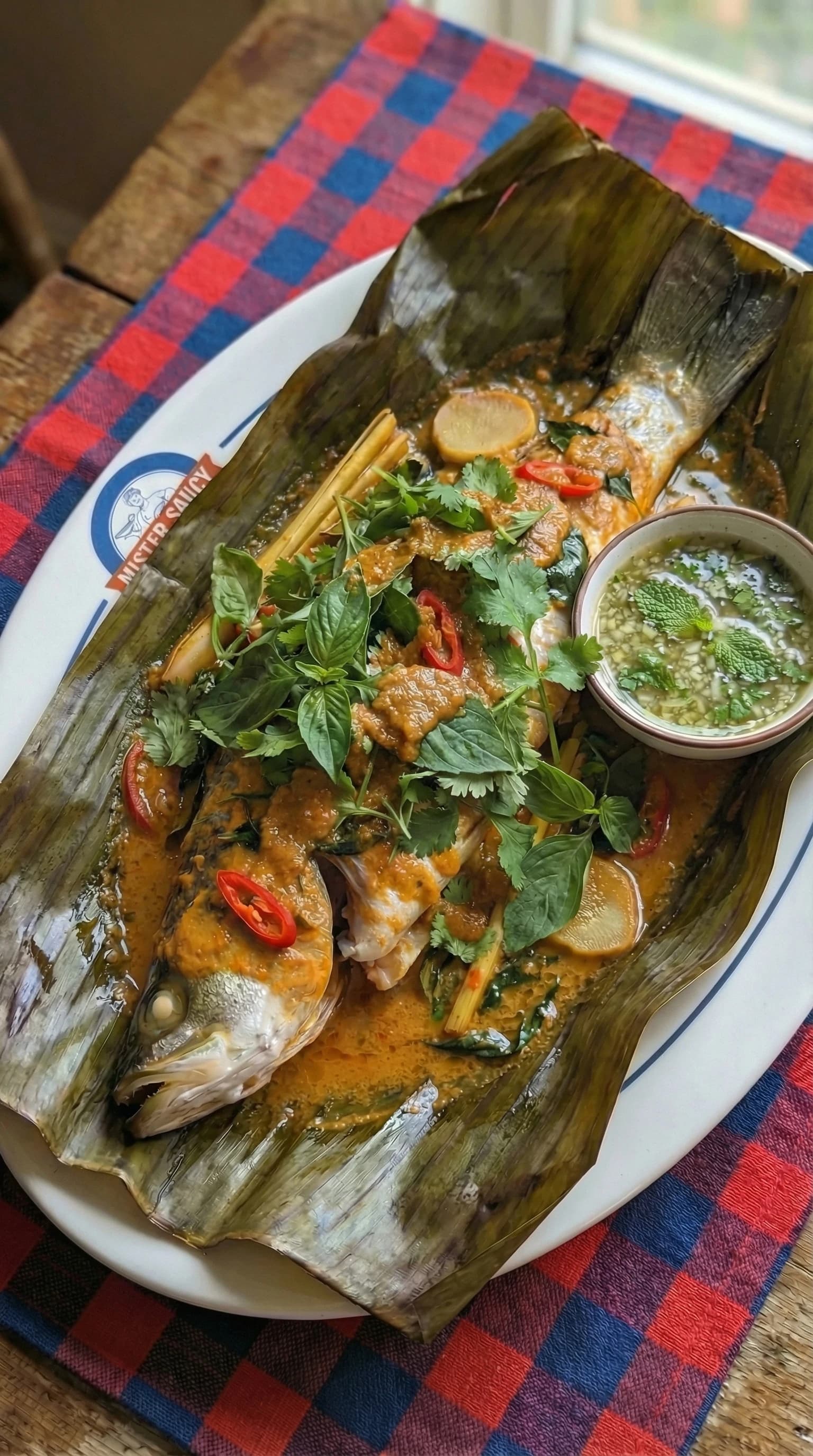
This is a stunning Thai-inspired whole fish dish where sea bass is wrapped in banana leaves with a rich coconut-curry custard and fresh herbs, then steamed until tender. The banana leaf acts like a natural steamer, keeping the fish incredibly moist while infusing it with lemongrass, ginger, and kaffir lime. Takes 45 minutes total and serves 4 people.

Recipe by Mr Saucy aka Christophe
Christophe is a culinary professional with expertise in French and global cuisine. He has developed recipes and cooking techniques that bridge traditional methods with modern home cooking approaches. Christophe focuses on making classic culinary techniques accessible to home cooks through clear instruction and practical applications. He studied at Le Cordon Bleu Paris and has work experience at a two star Michelin restaurant.
Homecook turned pro with a Cordon Bleu Paris graduate
Quick Info
How Does Steaming in Banana Leaves Create Such Tender, Flavorful Fish?
Traditional Thai cooking technique shows that banana leaves create a sealed environment that traps steam and aromatics. The tight wrap acts like a natural pressure cooker, forcing the herbal flavors deep into the fish while keeping every bite buttery and moist.
Food science shows that adding egg to the coconut curry transforms it from a thin sauce into a delicate custard. The proteins in the egg bind with the coconut cream during steaming, creating that signature 'Hor Mok' texture that clings to the fish instead of running off.
Professional chefs know that scoring the fish down to the bone isn't just for looks. Those cuts let the curry custard penetrate the thickest parts of the flesh, seasoning the fish from the inside out and ensuring every forkful is packed with flavor.
Ingredients
Recipe yields 4 servings
For the Fish
| Amount | Ingredient | Notes |
|---|---|---|
| 800 g (approx. 2 medium fish or 1 large) | whole sea bass or snapper | cleaned and scaled |
| 40 g (2 stalks) | lemongrass | white parts only, bruised |
| 20 g | fresh ginger | thinly sliced |
| 200 g | banana leaves | enough to double-wrap the fish |
For the Curry Custard
| Amount | Ingredient | Notes |
|---|---|---|
| 60 g (roughly 4 tbsp) | red curry paste | authentic Thai brand |
| 240 g (approximately 1 cup) | thick coconut cream | use the top thick layer of the can |
| 50 g (1 large) | egg | beaten, acts as a binder for the custard texture |
| 30 g (2 tbsp) | fish sauce (nam pla) | adjust to taste for saltiness |
| 15 g (1 tbsp) | palm sugar | finely shaved, balances the heat and salt |
For the Fresh Herbs
| Amount | Ingredient | Notes |
|---|---|---|
| 40 g | fresh Thai basil (horapa) | large handful of leaves |
| 30 g | sawtooth coriander or fresh cilantro | roughly chopped |
| 5 g (about 6-8 leaves) | kaffir lime leaves | de-veined and slivered |
| 10 g | red bird's eye chilies | sliced, adjust for heat preference |
For the Fresh Herbal Side Sauce
| Amount | Ingredient | Notes |
|---|---|---|
| 2 tbsp | lime juice | freshly squeezed |
| 1 tbsp | fish sauce | — |
| 1 tsp | palm sugar | — |
| 1 tsp | fresh ginger | grated |
| 1 handful | cilantro and mint | finely minced |
Instructions
Prep the Fish and Aromatics
- 1
Score the Fish (Let the Flavor In)
Make three deep cuts on each side of the fish, slicing down to the bone. These scores create pockets that let the curry custard penetrate the thickest parts of the flesh, ensuring every bite is seasoned all the way through instead of just on the surface.
- 2
Stuff the Cavity (Perfume from the Inside)
Place the bruised lemongrass stalks and ginger slices inside the fish cavity. This classic Thai technique infuses the fish from the inside out, filling it with warm aromatics that neutralize any fishy smell and add layers of flavor.
- 3
Soften the Banana Leaves (Make Them Pliable)
Pass the banana leaves quickly over an open flame or dip them in hot water for 30 seconds. This softens the fibers so they bend easily without cracking when you fold the parcel. You'll notice they turn a brighter green and become flexible.
Make the Curry Custard
- 4
Whisk the Custard Base (Create the Silky Texture)
In a bowl, whisk together the coconut cream, red curry paste, beaten egg, fish sauce, and palm sugar for at least 3 minutes. The vigorous mixing emulsifies the fats and proteins, turning the mixture into a smooth, mousse-like custard that will set beautifully during steaming instead of separating into watery layers.
- 5
Taste and Adjust (Balance the Flavors)
Before adding the raw egg, taste a small spoonful of the curry mixture. It should be balanced between salty, sweet, and spicy. If your curry paste is very salty, reduce the fish sauce. This is your chance to get the seasoning perfect.
Assemble and Steam
- 6
Create the Herbal Bed (Prevent Sticking)
Layer half of the Thai basil and kaffir lime leaves on the softened banana leaves, then place the stuffed fish on top. This herbal bed prevents the fish skin from sticking to the leaf and infuses the bottom of the fish with fresh aromatics.
- 7
Pour the Custard and Add Herbs (Layer the Flavors)
Pour the curry custard mixture over the fish, making sure it fills the scores and covers the top completely. Scatter the remaining fresh herbs and sliced chilies over the sauce. Layering herbs both underneath and on top maximizes that bright, garden-fresh profile.
- 8
Wrap Tightly (Seal in the Steam)
Fold the banana leaves over the fish to create a sealed envelope and secure with kitchen twine or toothpicks. The tight seal traps steam inside, which keeps the fish incredibly moist while concentrating all those herbal aromas. Make sure there are no gaps.
- 9
Steam Until Done (Watch for the Color Change)
Place the parcel in a large steamer over high heat and steam for 18-22 minutes. You'll know it's done when the parcel feels firm to the touch and the banana leaf has turned a deep olive green. For extra certainty, insert a thin metal skewer through the leaf into the thickest part—if it comes out warm when you touch it to your lip, the fish is perfectly cooked.
Finish and Serve
- 10
Make the Fresh Side Sauce (Add Brightness)
While the fish rests, whisk together 2 tbsp lime juice, 1 tbsp fish sauce, 1 tsp palm sugar, 1 tsp grated ginger, and a handful of finely minced cilantro and mint. This bright, acidic sauce provides a fresh contrast to the rich steamed custard.
- 11
Rest Before Opening (Let the Custard Set)
Let the parcel rest for 5 minutes before unwrapping. This lets the juices redistribute within the fish flakes, ensuring every bite is moist and flavorful.
- 12
Open at the Table (Maximum Drama)
Bring the whole parcel to the table and open it in front of your guests. The rush of aromatic steam is part of the experience. Add a final handful of fresh cilantro and a squeeze of lime juice the moment you open it to keep those herbal high notes vibrant.
Tips & Tricks
If you cannot find banana leaves: Use a double layer of parchment paper followed by a layer of foil to create a similar sealed environment. You'll miss the subtle tea-like aroma of the leaf, but the fish will still steam beautifully and stay moist.
If your curry sauce turned watery after steaming: This usually happens if the fish wasn't patted completely dry before assembly or if you used thin coconut milk instead of thick coconut cream. Always use the solid layer from the top of the can and whisk the egg thoroughly to bind everything together.
If you want maximum freshness: Save a handful of fresh cilantro and a squeeze of lime juice to add the very second the parcel is opened at the table. This keeps the bright herbal notes from fading during the steaming process.
If you're not sure if you should skip the egg: Don't skip it! The egg is the secret to the 'Hor Mok' style custard. It transforms the curry from a liquid sauce into a delicate, spoonable texture that clings to the fish instead of running off onto the plate.
If your curry paste is very salty: Reduce the fish sauce and always taste your curry mixture before adding the raw egg. The balance of salt, sweet, and spice should be perfect before you assemble the parcel.
If you want to make the side sauce ahead: Don't. The side sauce is best made fresh right before serving to keep the herbal high notes vibrant and prevent the lime juice from turning bitter. It only takes 2 minutes to whisk together.
Frequently Asked Questions
Can I use fish fillets instead of a whole fish?
Yes, but reduce the steaming time to 8-10 minutes since fillets cook faster. The whole fish is preferred for dinner parties because the bones provide extra gelatin, which makes the curry sauce richer and keeps the meat more succulent during steaming.
Why did my curry sauce turn watery?
This usually happens if the fish wasn't patted dry before assembly or if the egg wasn't whisked thoroughly into the coconut cream. Make sure you use thick coconut cream—the solid layer at the top of the can—rather than thin coconut milk, which has too much water.
How do I know if the fish is cooked without opening the leaf?
Use a thin metal skewer or cake tester and pierce through the leaf into the thickest part of the fish. Pull it out and touch it to your lip—if it feels warm, the fish is perfectly translucent and cooked through. This trick works for any wrapped fish dish.
Is the banana leaf edible?
No, the banana leaf is used strictly as a cooking vessel and aromatic wrap. It imparts a wonderful scent and protects the delicate fish during steaming, but it's too fibrous to eat. It does make for a beautiful, rustic presentation when opened at the table, though.
Can I make this dish ahead of time?
Yes. You can prep the curry custard and wrap the fish up to 4 hours ahead, then keep it refrigerated. Steam it fresh right before serving so the fish stays tender and the herbs stay bright. The side sauce should always be made fresh.
What if I don't have a large steamer?
Use a wok or large pot with a lid. Place a heatproof plate or rack inside, add water below it (not touching the plate), and set your wrapped fish on top. Cover tightly and steam over high heat. It works just as well as a traditional steamer.
Why do I need to bruise the lemongrass?
Bruising breaks open the fibers and releases the essential oils trapped inside. Just smack the stalks with the back of a knife or a rolling pin. This simple step makes the lemongrass much more fragrant and flavorful during steaming.
Can I freeze the leftover curry custard?
No, because of the egg. The custard will separate and turn grainy when thawed. It's best to make only what you need for the recipe. If you have extra coconut cream, you can freeze that separately before mixing in the egg.