

Lemongrass-Infused Red Curry with Pan-Seared Fish Balls & Garden Aromatics
Prefer not to cook?
Order Lemongrass-Infused Red Curry with Pan-Seared Fish Balls & Garden Aromatics as a ready-made meal and get it delivered to your door.
Order this meal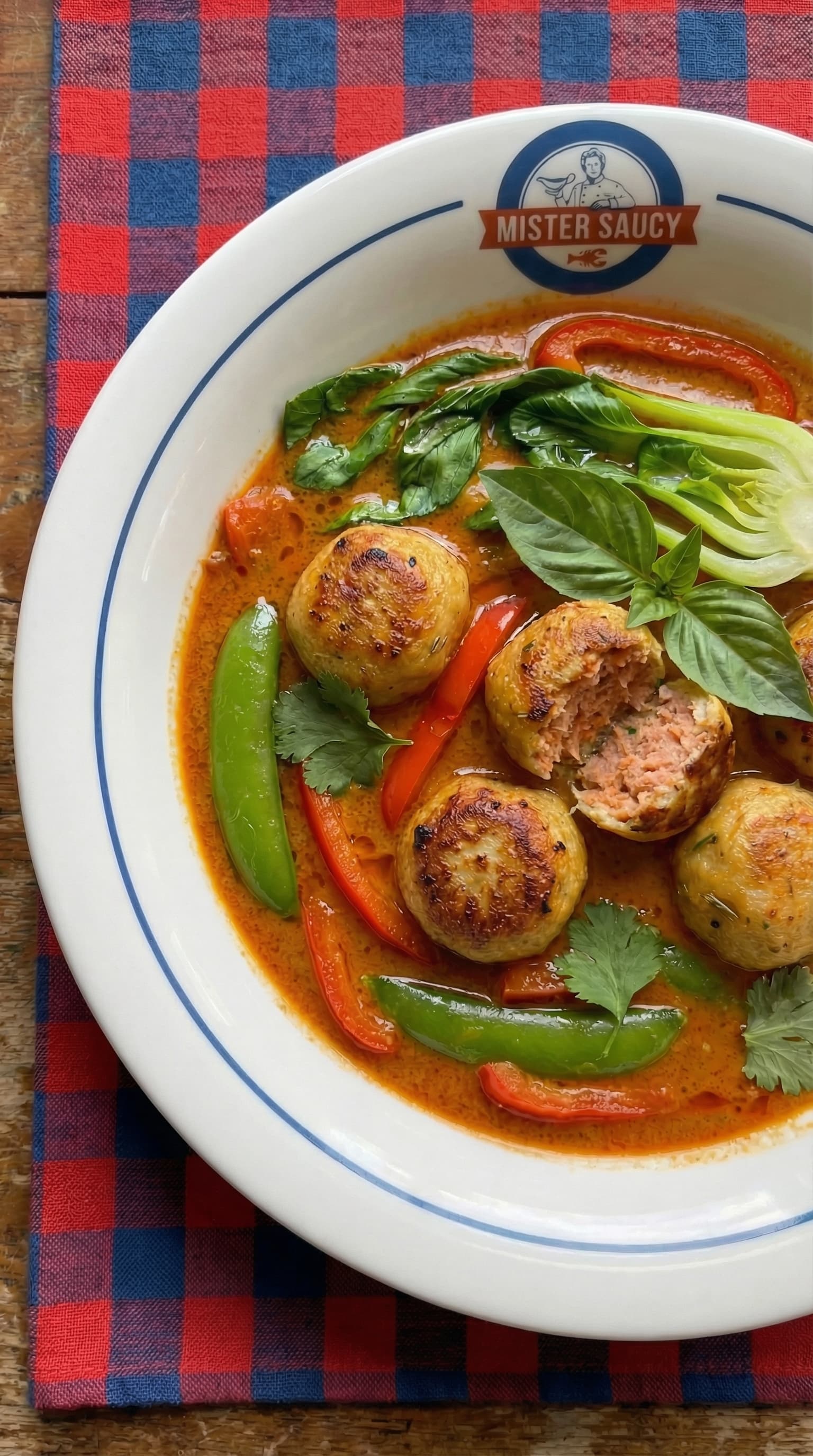
This Thai-French fusion dish features delicate fish balls made light and airy using French mousseline technique, then lightly dusted with flour and pan-seared until golden and served in a fragrant red curry with crisp vegetables. Takes about 55 minutes and serves 4 people.

Recipe by Mr Saucy aka Christophe
Christophe is a culinary professional with expertise in French and global cuisine. He has developed recipes and cooking techniques that bridge traditional methods with modern home cooking approaches. Christophe focuses on making classic culinary techniques accessible to home cooks through clear instruction and practical applications. He studied at Le Cordon Bleu Paris and has work experience at a two star Michelin restaurant.
Homecook turned pro with a Cordon Bleu Paris graduate
Quick Info
How Does This Create Such Light, Delicate Fish Balls?
Traditional French technique shows that keeping everything ice-cold while blending prevents the fish proteins from breaking down too early. When you add cold cream slowly while pulsing, you create tiny air pockets that make the fish balls fluffy instead of rubbery.
Professional chefs know that 'cracking the cream' releases the fat-soluble flavors locked in curry paste. Food science shows that simmering coconut cream until the oil separates, then frying the spices in that oil, creates deeper flavor than just stirring paste into liquid.
The light flour dusting combined with pan-searing creates what chefs call the Maillard reaction—that golden-brown crust that adds nutty flavor and forms a protective shell. This keeps the soft, mousse-like interior from falling apart when you add the fish balls to the hot curry.
Ingredients
Recipe yields 4 servings
For the Fish Balls
| Amount | Ingredient | Notes |
|---|---|---|
| 500 g (1.1 lbs) | firm white fish (cod, haddock, or monkfish) | chilled and cut into chunks |
| 100 g (7 tablespoons) | heavy cream | ice cold |
| 30 g (1 large egg white) | egg white | for binding |
| 22.5 g (1½ tablespoons) | red curry paste | for the fish mixture |
| 1 stalk | fresh lemongrass | finely minced |
| 4 g (4 leaves) | kaffir lime leaves | finely julienned |
| 30 g (1/4 cup) | all-purpose flour | for dusting |
| 45 g (3 tablespoons) | neutral oil | for pan-frying |
For the Red Curry Sauce
| Amount | Ingredient | Notes |
|---|---|---|
| 440 g (about 1.83 cups) | coconut cream | high fat content, no emulsifiers |
| 67.5 g (4½ tablespoons) | red curry paste | for the sauce |
| 2 stalks | fresh lemongrass | bruised with a knife |
| 15 g (1 tablespoon) | palm sugar or brown sugar | to balance heat |
| 16 g (about 2½ teaspoons) | fish sauce | adjust to taste |
| 30 g (2 tablespoons) | fresh lime juice | added at the end |
For the Vegetables & Garnish
| Amount | Ingredient | Notes |
|---|---|---|
| 150 g (5 oz) | baby bok choy | halved lengthwise |
| 100 g (3.5 oz) | sugar snap peas | trimmed |
| 80 g (½ medium pepper) | red bell pepper | thinly sliced |
| 7.5 g (about 1/4 cup leaves) | fresh Thai basil | whole leaves |
| 10 g (2 tablespoons) | fresh cilantro | for garnish |
| 4 g (4 leaves) | kaffir lime leaves | julienned for garnish |
Instructions
Make the Fish Balls
- 1
Blend the Chilled Fish
Pulse the chilled fish chunks in a food processor until they form a coarse paste. Keeping everything ice-cold (around 35°F / 2°C) is essential—warm fish proteins break down too early and create a rubbery texture instead of a light, airy one.
- 2
Create the Mousseline Emulsion
Add the egg white and 22.5 g (1½ tablespoons) of curry paste to the fish. With the processor running, slowly drizzle in the ice-cold heavy cream. This creates what French chefs call a 'farce fine'—a light, fluffy mixture with tiny air pockets that makes the fish balls delicate instead of dense.
- 3
Fold in the Aromatics
Stop the processor and fold in the minced lemongrass and half of the julienned kaffir lime leaves by hand with a spatula. Folding gently preserves the texture of the aromatics and keeps them from getting pulverized into the mixture.
- 4
Shape and Rest the Fish Balls
With wet hands, shape the mixture into 3 cm (about 1¼ inch) balls and place them on a plate. Chill in the refrigerator for 15 minutes. This resting time allows the proteins to set and firm up, so the balls hold together beautifully during frying.
- 5
Dust and Pan-Sear
Quickly run the chilled fish balls through a very thin layer of flour. Tap each ball thoroughly to ensure only a very fine coating remains. Heat the neutral oil in a non-stick skillet over medium heat and sear the fish balls, turning gently, until golden brown on all sides—about 6-8 minutes total.
Build the Red Curry Sauce
- 6
Crack the Coconut Cream
In a heavy-bottomed saucepan, simmer 110 ml (about 0.46 cup) of the coconut cream over medium heat until the oil separates and pools on the surface—this takes about 3-4 minutes. Then fry 67.5 g (4½ tablespoons) of curry paste in that separated oil for 1-2 minutes. This 'cracking' technique releases the fat-soluble flavors locked in the spices, creating much deeper taste than just stirring paste into liquid.
- 7
Simmer with Aromatics
Add the remaining coconut cream, bruised lemongrass stalks, and palm sugar to the pot. Simmer gently at medium-low heat (around 185°F / 85°C) for 8 minutes. The long, gentle simmer allows the woody lemongrass to infuse the sauce with deep citrus oils without burning.
Add Vegetables and Finish
- 8
Cook the Vegetables Until Tender-Crisp
Add the baby bok choy, sugar snap peas, and red bell pepper to the curry sauce. Simmer for 2-3 minutes until the vegetables are tender-crisp and still vibrant green. They should provide a bright, crunchy contrast to the soft fish balls and rich sauce.
- 9
Finish with Fresh Flavors
Remove and discard the bruised lemongrass stalks. Stir in the lime juice, 16 g (about 2½ teaspoons) fish sauce, and 7.5 g fresh Thai basil leaves just before serving. Adding these at the very end preserves what chefs call the 'high notes'—the bright, fresh flavors that would fade if cooked too long.
- 10
Plate and Serve
Place the warm fish balls into serving bowls and pour the fragrant curry and vegetables around them. This presentation keeps the pan-fried exterior crisp rather than soggy. Garnish with fresh cilantro and extra julienned kaffir lime leaves.
Tips & Tricks
If your fish mixture is too soft to roll into balls: Use two spoons to form 'quenelles' (football shapes) and drop them directly into the hot pan. Or chill the mixture for an extra 10 minutes to firm it up before shaping.
If your coconut cream won't separate or 'crack': Modern coconut milks often have emulsifiers that prevent separation. Use high-quality coconut cream with no additives, or simply sauté the curry paste in 1 tablespoon of neutral oil before adding the cream.
If your fish balls fall apart during cooking: Make sure your fish was extremely dry before processing—pat it with paper towels. Excess moisture prevents the proteins from binding properly. Also, don't skip the 15-minute chill time and the light flour dusting.
If your curry sauce tastes too salty: Some commercial red curry pastes are already very salty. Always taste the sauce before adding fish sauce, and add it gradually—you can always add more but you can't take it out.
If your vegetables are mushy instead of crisp: Don't overcook them. They only need 2-3 minutes in the hot curry. Pull them off the heat when they're still bright and slightly crunchy—they'll continue cooking a bit from residual heat.
If you don't have kaffir lime leaves: Use regular lime zest plus a bit of extra lemongrass to compensate. Kaffir lime has a unique floral aroma, but this substitution will still give you bright citrus notes.
Frequently Asked Questions
Why do I need to use heavy cream in a fish ball?
The cream acts as a fat source that, when combined with the egg white and fish protein, creates what French chefs call a 'mousseline.' This results in a texture that's much lighter and more sophisticated than a standard rubbery fish ball—it's almost fluffy inside with a delicate mouthfeel.
Why do we dust the fish balls in flour?
The flour helps the fish balls brown more evenly and creates a slightly more robust crust that stands up better to the moisture of the curry sauce. Just be sure to tap off the excess!
Can I make the fish balls ahead of time?
Yes! Shape the fish balls and refrigerate them (covered) for up to 24 hours before cooking. You can also pan-sear them, let them cool, and refrigerate for up to 2 days. Reheat gently in the curry sauce just before serving.
Can I use lemon instead of lime?
While lemon provides acidity, lime (especially kaffir lime) has a specific floral aroma that's essential for authentic red curry flavor. If you must use lemon, add a bit of extra lemongrass zest and a pinch of lime zest if you can find it to compensate for the missing floral notes.
What if I don't have a food processor?
You can finely mince the fish by hand with a sharp knife, then mix it vigorously with the other ingredients in a bowl set over ice. It takes more effort, but you'll still get a good texture. Just make sure everything stays very cold.
Can I substitute the vegetables?
Absolutely. Asparagus, bamboo shoots, green beans, or baby corn also pair beautifully with this lemongrass and red curry profile. Just keep the cooking time short so they stay crisp and colorful.
How do I bruise lemongrass properly?
Hit the lemongrass stalk with the back of a heavy knife or a rolling pin until it splits and flattens slightly. This breaks the internal cells and releases the aromatic oils into your curry. You'll smell the difference immediately.
Is this dish very spicy?
It depends on your curry paste brand. Most red curry pastes have moderate heat. If you're sensitive to spice, start with 2 tablespoons of paste in the sauce instead of 3, then taste and add more if needed. The sugar and coconut cream help balance the heat.
Can I freeze the fish balls?
Yes. Freeze the shaped, uncooked fish balls on a baking sheet until solid, then transfer to a freezer bag for up to 2 months. Pan-sear them directly from frozen—just add 2-3 extra minutes to the cooking time.